

Introduction to Islamic banking and finance
- Introduction
Islamic Banking is simply a system of financial activities that follow the Shari’ah principles, such as prohibition of interest, uncertainty (Gharar) and speculation in transactions. Islamic Banking is not exclusive to Muslims. Instead, it is available to everyone, regardless of their race, religion or color. And everyone equally enjoys the benefits of this type of banking.
- Shari’ah Basis
Premier Bank Kenya adheres to the Shari’ah Basis. This has allowed us to stand out as a bank with a conscience, and this is for the betterment of all our customers and staff. Shari’ah is a set of norms, values and laws that govern – the Islamic way of life. It governs all aspects of Islam including worship, economic, social and cultural aspects of Islamic society. Generally, Islam means submission to One God, Allah. This is the essence of all divine revelations since creation of Adam down to all other prophets including Noah, Abraham, Moses, Jesus and finally Prophet Muhammad (peace be upon them).
- Fundamental principles of Islamic Banking and Finance
Islamic banking adheres to fundamental business principles of fair dealing, justice and honesty.
3.1 Prohibition of riba (interest)
Riba is the stipulated excess without a counter value in both sale and loan. Shari’ah does not recognize money as a subject matter of trade, but only as a medium of exchange. It is stated in the Holy Qur’an that, “Allah has permitted trade and has forbidden interest.” (Qur’an 2:275). Its prohibition is to ensure justice and equity in commercial transactions.
3.2 Prohibition of speculative behavior
This includes transactions that have both Gharar and Maysir elements. Gharar includes excessive uncertainty such as lack of transparency, deception, ignorance, unspecified price and unspecified date of exchange among others. While Maysir means gambling, and this is where the winner takes the entire bet, and the loser loses his bet.
3.3 Prohibition of unlawful activities
These are business activities that violate Shari’ah rules. This includes financing businesses that relate to gambling, alcohol, tobacco, pork production and extending loans purely for profitable purposes.
3.4 Risk Taking
Islamic banking is based on the principle of mutual risk and profit sharing instead of pure borrowing – lending. For example, financing extended based on Murabaha Sale requires the financier (bank) to purchase a commodity and to assume the risk of the commodity before selling it to the customer. Whereas in Mudaraba financing, the capital provider (customer) and the entrepreneur (bank) share business risks in return for a share of the profit.
- Shari’ah Contracts
The Bank – Customer relationship is contractual in nature, and all banking and finance transactions are based on the Shari’ah law of contract and the laws that govern specific transactions. The relationship varies depending on the underlying contract of a transaction.
4.1 Services Based Shari’ah Contracts
Service Based Shari’ah Contracts include Ujra (fee) where the Bank renders a service the customer such as cash withdrawal, money remittances among many others for a fixed fee.
4.2 Deposit Taking Shari’ah Contracts
4.2.1 Qardh
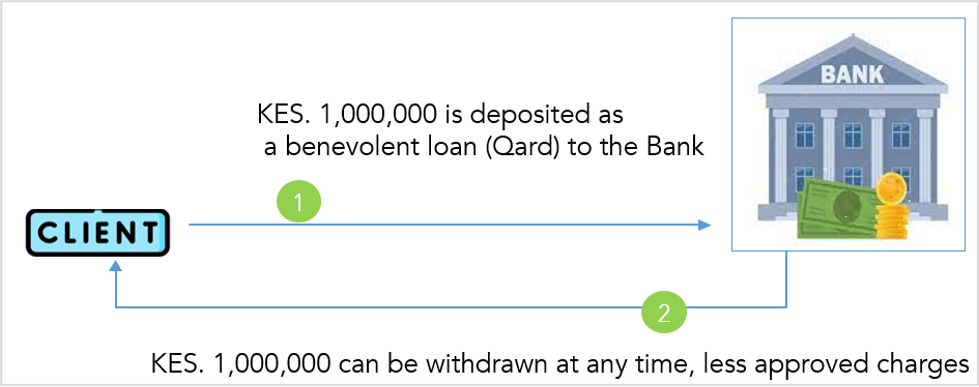
The depositor is deemed as a lender and the bank acts as a borrower. The bank guarantees return of an equivalent of the amount deposited even if there is negligence or loss of wealth. The aim is to provide the depositors with a guaranteed safe – keeping of the amount deposited, and at the same time allow the bank to utilize it for its banking activities. Examples of Qardh Contracts at Premier Bank Kenya are Personal Current Accounts and Lulu Plus Account.
Application
Qardh Contract is applied on current accounts and the follow are advantages of having a current account with Shari’ah compliant banks:
- Your money in Shari’ah compliant Banks is safely invested in ethical business activities.
- Your money in Shari’ah compliant Banks is not given out through Riba loans.
Disadvantages of having a current account with conventional banks
- Your money may be invested in unethical businesses.
- Your money is given out through Riba loans.
Qardh Process
4.2.2 Mudarabah
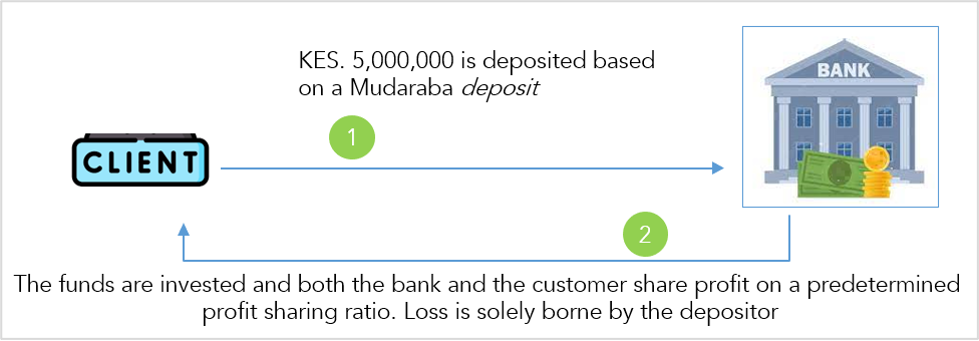
It is a form of investment account where the depositor provides funds and the bank acts as a manager of the funds by investing them in Shari’ah compliant investments. The distribution of profit between the bank and the depositor is in accordance to a mutually pre–agreed profit sharing ratio.
Application and Features
- Mudarabah Contract is applied on savings and Fixed Maturity accounts.
- Islamic savings accounts are different from conventional savings accounts in that your money in Islamic savings accounts is invested in ethical and Shari’ah compliant business activities which do not harm the individual, the society and the environment.
- Also, what is shared in Islamic savings accounts is the real profit generated from Shari’ah compliant investment activities.
Mudarabah Process
4.3 Financing Shari’ah Contracts
4.3.1 Tawarruq
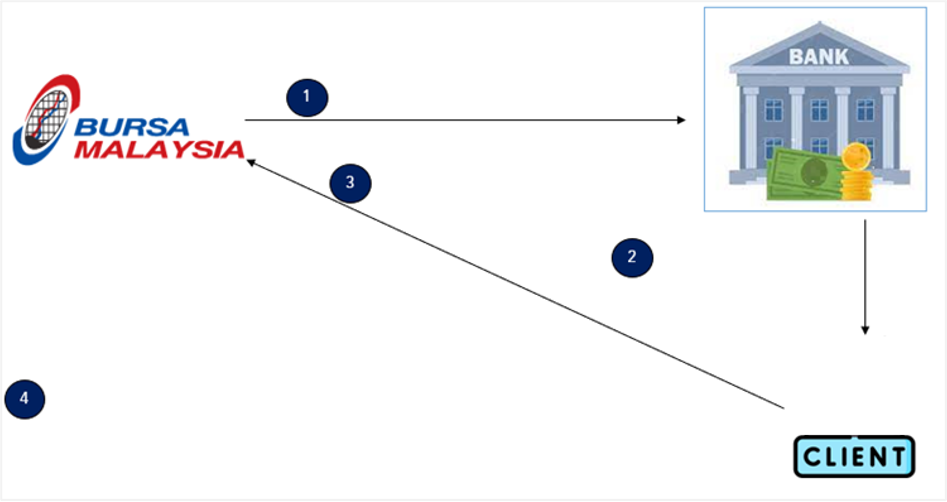
It implies a mean of obtaining liquidity through purchasing of a commodity on deferred basis from the bank and selling it to a person other than the initial seller for a lower price on a cash basis.
Application
Tawarruq is applicable in various Islamic banking products such as deposits facility and placement, personal financing, asset financing, working capital financing and project financing facilities. It is also used in liquidity management, risk management and hedging purposes.
Tawarruq Process
4.3.2 Murabaha
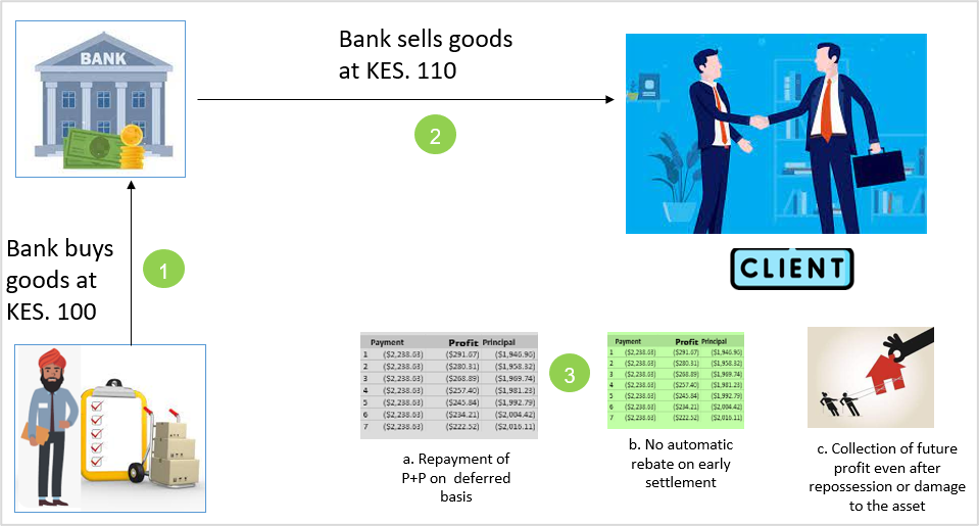
It is a contract where the seller expressly mentions the cost of the sold commodity he has incurred and sells it to another person by adding a profit margin. It requires a real sale of commodity and not merely advancing a facility.
Application
It is used in various financing such as personal financing, trade financing and asset financing.
Murabaha Process
4.3.3 Diminishing Musharakah (DM)
It is a financing structure where a customer and the bank enter into a partnership to purchase an asset and thereafter the customer undertakes to gradually purchase the bank’s share in the asset until all the bank’s shares are purchased by the customer in addition to the customer paying monthly rentals for using the bank’s share in the asset. This financing structure combines separate transactions such as partnership (Musharakah), leasing (Ijarah), promise (Wa’d) and sale (Bay’).
Features
- In case of early settlement, future usage fee (rental/profit) should be waived.
- In case of repossession of the financed asset (say Motor Vehicle), the client should not pay usage fee (rental/profit) during of the repossession period.
- In case financing rates change (increase/decrease), the usage fee (rental/profit) also changes.
- In case the Motor Vehicle is no longer usable in a period, the bank should not collect usage fee (rental/profit) in that period.
- In case the Motor Vehicle is destroyed, not by the customer, then both the customer and bank bear the loss.
Application
Diminishing Musharakah can be used to jointly finance purchase of Shari’ah compliant assets such as Motor vehicles, land among many others.
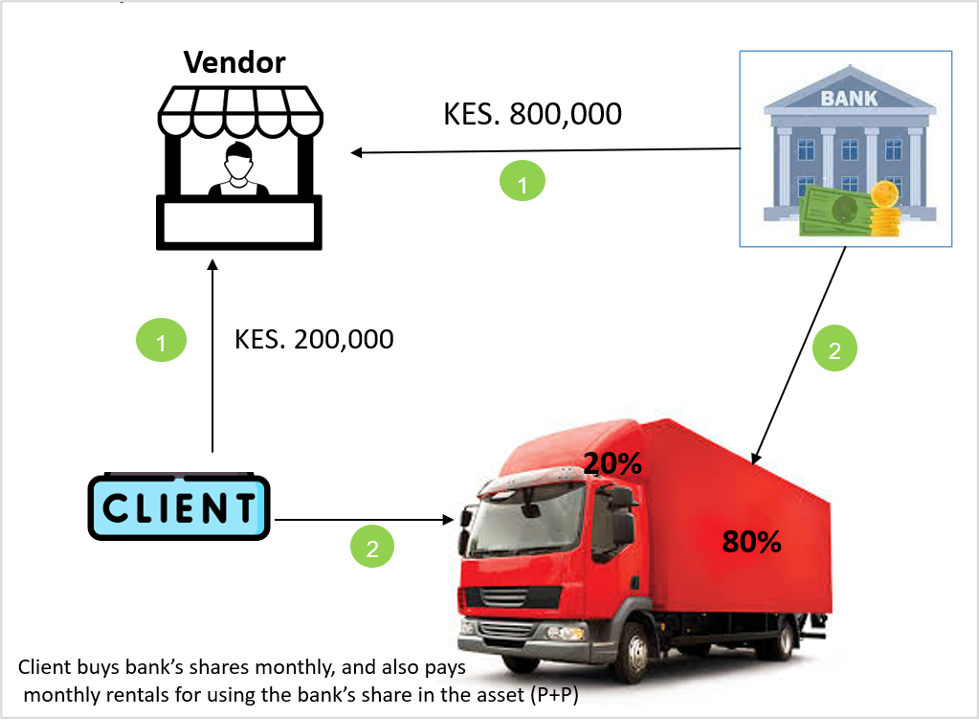
4.3.4 Diminishing Musharakah Sale and Lease Back (DM S&LB)
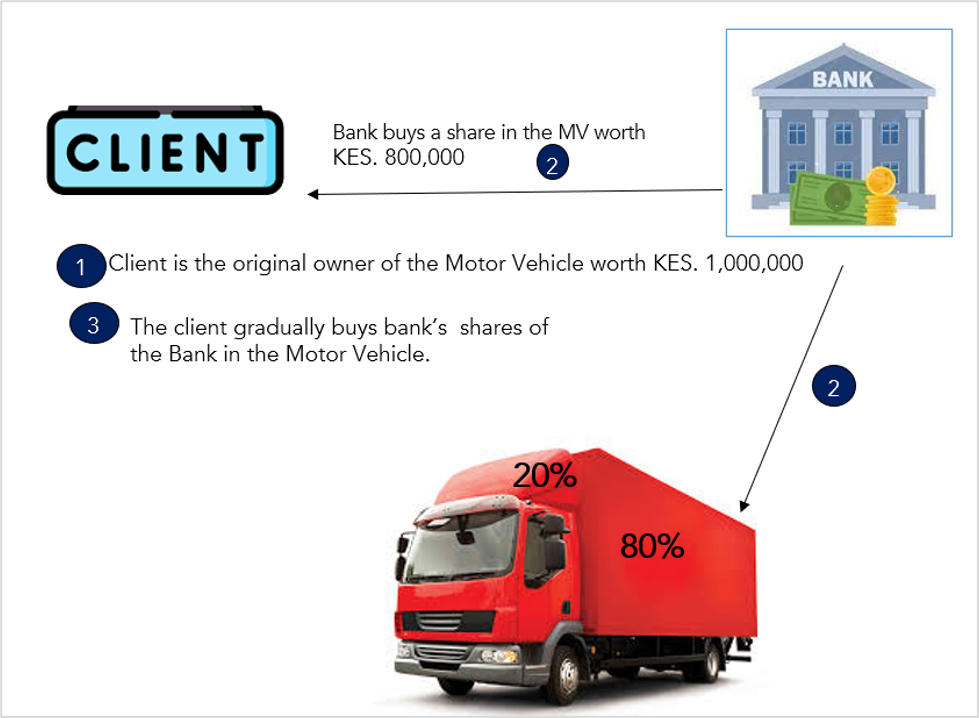
This is the same as DM, but in this case, the asset originally belongs to the customer as shown in the picture below.
Features
- DM Sale & Lease Back is applicable in working capital finance.
- In case of early settlement, future usage fee (rental/profit) should be waived.
- In case of repossession of the financed asset (say Motor Vehicle), the client should not pay usage fee (rental/profit) during of the repossession period.
- In case financing rates change (increase/decrease), the usage fee (rental/profit) also changes.
- In case the Motor Vehicle is no longer usable in a period, the bank should not collect usage fee (rental/profit) in that period.
- In case the Motor Vehicle is destroyed, not by the customer, then both the customer and bank bear the loss.
4.5 Trade Finance Shari’ah Contracts
Trade Finance Shari’ah Contracts include all the aforementioned Financing Shari’ah Contracts in addition to: Kafalah and Wakalah.
Kafalah contract is applied in Guarantees where the Bank guarantees a customer in favor of a beneficiary. This service is charged based on the real costs incurred by the Bank in issuing the Guarantee.
Wakalah is applied in Documentary collection done on behalf of the customer for a specific fee.
4.6 Treasury Shari’ah Contracts
Treasury Shari’ah Contracts include Swarf which is applied in Foreign Exchange, Wa’d as applied in Foreign Exchange Swaps. Tawarruq, Mudarabah and Wakalah are applied in Interbank transactions.
PART 2: ISLAMIC BANKING GLOSSARY
- Al-Bay’ – Sale contract
- Gharamah – Fine/Penalty
- Hibah- Gift
- Ibra’- Rebate/waiver of partial or total against certain right or debt
- Ijarah- Lease or service contract that involves benefit/ usufruct of certain asset or work for an agreed payment or commission within an agreed period
- ‘Iwad- Consideration
- Kafalah- Guarantee
- Maysir- Gambling
- Mudaraba- Profit Sharing and loss bearing Contract
- Murabaha- Sale contract with disclosure of the asset’s cost price and addition of a profit margin to the buyer
- Musharakah- Profit Loss Sharing Contract
- Musharakah Mutanaqisah- A contract of partnership that allows one partner to give a right to gradually own his share of the asset to the remaining partners based on agreed terms
- Qardh – Loan contract
- Rahn- Pledge/charge
- Ta’widh- Compensation
- Tabarru’- Voluntary donation/contribution
- Takaful- A scheme which is based on the spirit of corporation and helping each other by providing financial assistance to participants when needed. All participants mutually agree to give contribution as charity for the said purpose
- Tawarruq- Purchasing an asset with deferred price, either on the basis of bargain or markup cost, then selling it to a third party to obtain cash
- Ujrah- commission
- Wa’d- Promise
- Wadi’ah- Safe keeping contract in which a party entrusts his property to another party for safe keeping and to be returned upon request
- Wakalah- Agency contract
PART 3: SHARI’AH FREQUENTLY ASKED QUESTIONS:
What is Islamic Banking?
Islamic Banking is a system of banking that is in accordance with the teachings of Shari’ah (Islamic Law).
What is Shari’ah?
It is a set of norms, values and laws that govern the Islamic way of life. It therefore embodies all aspects of Islam including beliefs and practices. It is derived from The Holy Qur’an, Sunnah (sayings and actions of Prophet Muhammad – Peace Be Upon him), Ijmaa (consensus of Shari’ah scholars) and Qiyas (Analogy).
What is the difference between Islamic and non-Islamic banking?
Islamic banking is based on principles of Shari’ah, and unlike non – Islamic banking, all aspects of Islamic banking including transactions, products, business approach and investments are in compliance with Shari’ah.
What are the basic principles of Islamic banking?
The principles include among others, mutual risk and profit sharing, prohibition of riba (Interest or usury), prohibition of speculative behavior and prohibition of unlawful activities.
Why choose Islamic banking if the end results are the same as non-Islamic banking?
In Islam, the validity of a transaction does not depend on the result but rather on the process of achieving the result. Therefore, the underlying transaction through contracts’ and products’ structure makes the process used in Islamic banking different from non-Islamic banking.
How do Islamic banks operate if they don’t charge interest?
Interest (riba) is prohibited in Islam. Islamic banks earn profit through Shari’ah compliant related trade, investment and banking services.
Why is interest prohibited in Shari’ah?
There are various reasons as to why interest (riba) is prohibited in Shari’ah. One of the primary reasons is that its existence in an economy is a form of economic and social exploitation. This is so when the lender is guaranteed a positive return without assuming a share of risk with the borrower, whereas the borrower takes all sorts of risk in addition to his skill and labor.
Does Prohibition of interest deny Time Value of Money?
Shari’ah recognizes time value of money hence acknowledges its compensation in sale contracts and not in lending contracts. Time, by itself does not give yield, but only contributes to the creation of value when an economic activity is undertaken.
Is Islam the only religion that prohibits interest?
No, other faiths such as Christianity, Hinduism and Judaism prohibit charging of interest. For instance, this is evident in the Bible in the books of Exodus 22:25, Leviticus 25:36, Proverbs 28:8 and Ezekiel 18:8.
Why do Islamic banks charge fee on late payment?
In principle, it is not allowed for Islamic banks to charge penalty fee. However, Shari’ah Scholars have allowed it on the delinquent. In such a case, the proceeds of the penalty are channeled to charity. The bank’s Shari’ah Supervisory Board ensures that the bank does not directly or otherwise benefit from the charity funds.
How does an Islamic bank operate in a non-Shari’ah compliant environment?
Islamic banks like any other banks are subjected to the rules and regulations of the Central Bank. The regulator has allowed Islamic banks to operate in the country within the legal and Shari’ah frameworks.
How do Islamic banks apply Shari’ah concepts and standards?
Islamic banks have both a Shari’ah Department and an independent Shari’ah Supervisory Board that ensures Shari’ah concepts and standards are applied in all banking activities. Therefore, before offering any products or services to the public, the bank must get Shari’ah Board’s approval.
What is the role of the Shari’ah Supervisory Board?
The Board plays an important role in ensuring that all banking activities are in accordance with Shari’ah. Therefore, the board reviews, approves, supervises and audits the bank’s transactions, contracts and products structures.
How independent is the Shari’ah Supervisory Board?
The members of Shari’ah Supervisory Board are neither employees nor have executive roles in the bank. They are independent, qualified Shari’ah experts appointed by the bank’s stakeholders at the Annual General Meeting.
Is Islamic banking only meant for Muslims?
No, Islamic teachings are universal in nature. Thus, values such as free consent, ethics, social responsibility, justice and honesty among others form the principles of Islamic banking.